















4 Female Pioneers Who Changed the World of Travel.

Authors / Photo source: Pixabay.
Contents:
- Jeanne Baret: how a maid became the first woman to circumnavigate the globe.
- Isabella Bird: from a chronically ill recluse to a legend of Victorian travel.
- Alexandra David-Néel: the woman who entered forbidden Lhasa.
- Nellie Bly: the journalist who beat Jules Verne.
International Women’s Day was born as a symbol of the struggle for freedom and equality. One of the most radical expressions of that freedom was travel.
Just imagine: only 150 years ago, a “respectable” woman could not leave her home without a chaperone. Traveling to other countries was out of the question. Women were believed to be too fragile, too emotional, too helpless for long journeys. And yet, there were always those who risked their reputation, their health, even their lives — and changed the world. Today we remember the women who proved that travel has no gender.
Jeanne Baret: how a maid became the first woman to circumnavigate the globe.

Authors / Photo source: By Unknown - 18th century print. Originally found in Navigazioni di Cook del grande oceano e intorno al globo, Vol. 2 (1816) d'après Cristoforo Dall'Acqua (1734-1787)., Public Domain, https://commons.wikimedia.org/w/index.php?curid=4209183.
1766. The French navigator Louis Antoine de Bougainville assembles an expedition for a voyage around the world. Women are strictly forbidden on board a naval ship — it is the law. Yet a “young man” named Jean Baré steps onto the deck, assistant to the botanist Philibert Commerson. In reality, this is Jeanne Baret — a former governess, the scientist’s partner, and a passionate botanist. She cuts her hair, dresses in men’s clothing, and lives among 300 sailors for two and a half years, keeping her secret.
Jeanne worked alongside the crew: collecting plants in the jungles of Brazil, climbing the cliffs of Patagonia, studying the flora of Tahiti. She carried heavy herbariums, slept in a hammock, and ate sailors’ stew. In total, the expedition gathered more than 6,000 plant species — a significant portion thanks to her work.
She was exposed only in Tahiti — the locals immediately recognized her as a woman. Formally, Jeanne was put ashore in Mauritius, yet she still completed the circumnavigation, returning to France across the Indian Ocean in 1769.
She received no official recognition during her lifetime. But 200 years later, the plant Solanum baretiae was named in her honor, and a memorial plaque was installed.
Isabella Bird: from a chronically ill recluse to a legend of Victorian travel.

Authors / Photo source: Public Domain, https://commons.wikimedia.org/w/index.php?curid=1435955.
Isabella Bird spent much of her life confined to bed. Doctors diagnosed her with one condition after another: a weak spine, nervous exhaustion, insomnia, depression. At 40, she looked 60 and was considered a hopeless invalid. But as soon as she left the stuffy Victorian drawing rooms of England, her illnesses seemed to vanish.
In 1854, at the age of 23, Isabella traveled to America “to improve her health.” Instead of sanatoriums, she found herself in the saddle, traveling through the wild territories of Colorado. She climbed the peaks of the Rocky Mountains, spent nights in hunters’ cabins, crossed icy rivers.
For the next 40 years, she traveled: Japan, China, Vietnam, Korea, Turkey, Persia, Kurdistan, Tibet, Morocco. She rode horses, yaks, elephants. She slept in tents, monasteries, dugouts. At 60, she walked 1,000 kilometers through the mountains of China. At 70, she undertook an expedition in Morocco through territories where no European had set foot.
Isabella wrote books that became bestsellers. Geographers and ethnographers used her photographs and notes. In 1892, she became the first woman admitted to the prestigious Royal Geographical Society.
The paradox: whenever she returned to England, Isabella would weaken and fall ill again. Travel was her medicine.
Alexandra David-Néel: the woman who entered forbidden Lhasa.
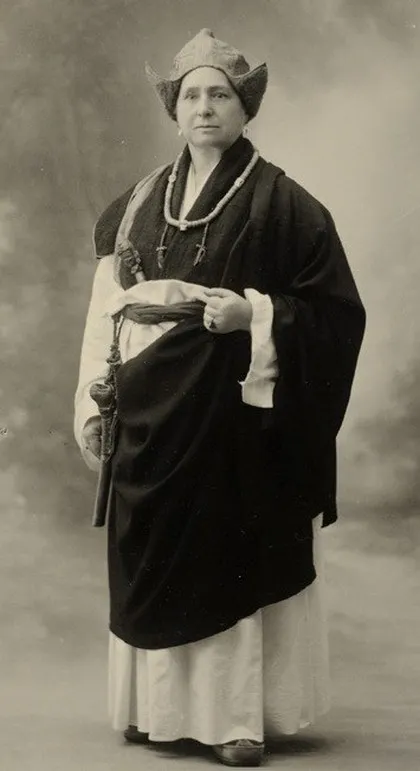
Authors / Photo source: By Preus museum - Flickr: Alexandra David-Neels, CC BY 2.0, https://commons.wikimedia.org/w/index.php?curid=14876154.
Alexandra David-Néel lived a life that could have filled three. Opera singer, anarchist, Buddhist, writer, traveler, explorer of Tibet — all in one person.
Born in 1868 in Paris, she dreamed of Asia from childhood. At 18, she ran away from home to Switzerland. At 36, she married a wealthy engineer — but only on the condition that he finance her travels and that she would live wherever she wished. He agreed. They corresponded for 40 years but saw each other only a handful of times.
In 1911, Alexandra left for India — and remained in Asia for 14 years. She studied Tibetan Buddhism in monasteries, meditated in Himalayan caves, and met the 13th Dalai Lama. She adopted a Tibetan boy, Yongden, who accompanied her on her journeys.
In 1924, at the age of 55, Alexandra accomplished the impossible: on foot, across snow-covered Himalayan passes, disguised as a beggar pilgrim, her face darkened with soot, she entered Lhasa — the sacred city of Tibet, closed to Europeans. The journey took four months. They survived on alms, slept in caves, and risked being killed by bandits.
Alexandra spent two months in Lhasa studying monasteries and rituals. By the time she was discovered, she had already gathered unique materials that formed the basis of dozens of books about Tibet. She lived to 101, traveled until the age of 80, and remained a rebel to the end of her life — proving that age, gender, and convention are no obstacle to those who truly wish to see the world.
Nellie Bly: the journalist who beat Jules Verne.
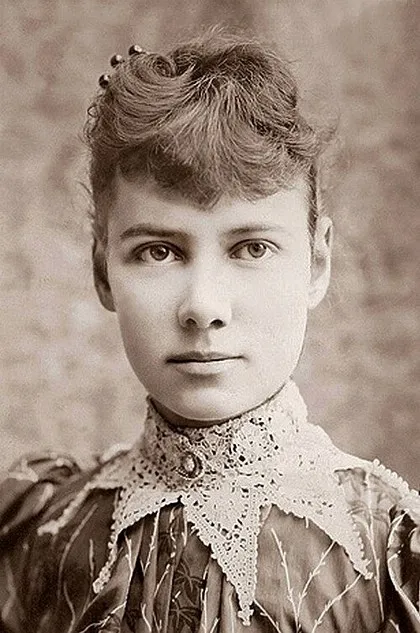
Authors / Photo source: By H. J. Myers, photographer - From the United States Library of Congress's Prints and Photographs divisionunder the digital ID cph.3b22819. Public Domain, https://commons.wikimedia.org/w/index.php?curid=478187.
Nellie Bly (born Elizabeth Cochran) grew up in a poor family but refused to accept injustice from an early age. At 18, she wrote an angry letter to a newspaper in response to an article titled “What Girls Are Good For” about women’s roles. The editor was so impressed that he hired her — at a time when female journalists were rare.
Nellie did not write about fashion or cooking. She worked undercover in factories to expose the exploitation of women workers. She feigned mental illness to be admitted to a psychiatric asylum and described the horrific conditions inside. Her reports changed laws. But her true fame came from a journey around the world.
In 1889, Nellie proposed to the newspaper New York World that she repeat the route of the hero of Jules Verne’s novel Around the World in Eighty Days — but faster. Alone. Without accompaniment. On November 14, she set off with just one small bag. Steamships, trains, rickshaws, sampans — Nellie raced across Europe, Asia, and the Pacific Ocean. The whole world followed her journey through telegraph updates. In Amiens, she even met Jules Verne himself, who shook her hand and wished her luck.
On January 25, 1890 — after 72 days, 6 hours, and 11 minutes — Nellie returned to New York. Thousands of people, orchestras, and fireworks greeted her. She became a global celebrity. Nellie proved that a woman could travel light, fast, alone — and safely. She shattered the stereotype of female helplessness on the road.
Today, many women can buy a ticket, board a plane, a train, or arrange an airport transfer — and go anywhere. It feels natural. But just 100 years ago, it was impossible. The right to travel freely is the achievement of those very women in trousers and jackets who risked their reputation, health, and lives to prove that the world is open to everyone. May every journey remind us of the freedom these remarkable women fought for. Happy International Women’s Day!
More travel photos in our Telegram channel.
Read also other Intui travel news: Mauritius — an Alternative to the Maldives! Discover an Island Where Vacation Meets Adventure.
Intui offers the opportunity to earn money for bloggers and experts in the field of tourism by participating in an affiliate program.
Petrichenko Rimma & Intui travel


