

5 global destinations for a date with infinity.

Authors / Photo source: Pexels.
Contents:
- London: The Royal Observatory Greenwich and the Prime Meridian.
- Los Angeles: Griffith Observatory Above Hollywood.
- Athens: An Observatory on the Hill of the Nymphs, Facing the Acropolis.
- Geneva: CERN and the Globe of Science and Innovation.
- Paris: The World's Oldest Working Observatory.
Some of the buildings on this list are working research institutes with centuries of history, others are museums built for curious kids and adults alike, but they all share one thing: behind the facade there's always a dome where people have spent centuries chasing the same question – what's actually out there, past the edge of the visible sky. A city break usually revolves around waterfronts, restaurants and museums full of paintings, but each of these cities also hides a door into the universe, for anyone willing to skip an hour of sightseeing and just look up. Almost every one of them doubles as one of the best viewpoints in its city, and makes a genuinely great family outing on top of that – kids get a real telescope and a dome instead of a textbook, adults get that rare feeling of complicated science suddenly making sense.
London: The Royal Observatory Greenwich and the Prime Meridian.
Authors / Photo source: Wikimedia Commons.
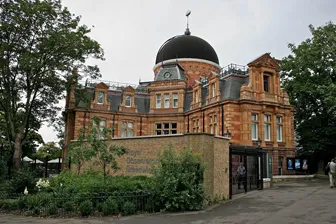
The Royal Observatory in Greenwich is one of Britain's oldest scientific institutions, founded in 1675, and the spot where the Prime Meridian runs through – you can stand with one foot in the Eastern Hemisphere and the other in the Western, as if the planet let you split yourself in two just for a photo. Inside is Flamsteed House with its historic telescopes, the Peter Harrison Planetarium, where an artificial sky turns real for a few minutes under the dome, and a maritime museum holding John Harrison's chronometer, the instrument that finally solved the centuries-old riddle of measuring longitude at sea by the stars.
The viewpoint on the hill in Greenwich Park happens to offer one of the best views over London and the Canary Wharf skyline – and, on a clear evening, the first stars coming out above the city.
A private transfer from Heathrow Airport will take you to central London, and from there a river boat down the Thames covers the last leg to Greenwich – part of the experience in itself.
Los Angeles: Griffith Observatory Above Hollywood.
Authors / Photo source: Pexels.
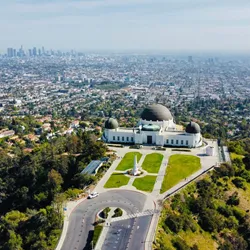
Griffith Observatory sits on the slope of Mount Hollywood and has been one of Los Angeles's most recognisable landmarks for nearly a century – its domes have shown up on screen more than once. Inside, the Samuel Oschin Planetarium runs one of the most powerful star projectors in the world, turning the permanently light-polluted LA sky into a proper starfield for an hour, and the Zeiss telescope is open to the public for free on clear nights, if you don't mind a line to catch Saturn's rings.
The terrace by the entrance is one of the best spots to catch the HOLLYWOOD sign and the skyline stretching out to the ocean, especially at dusk, when the city's lights switch on one by one.
A private transfer from Los Angeles Airport will take you to Hollywood, and a shuttle bus covers the last stretch up the hill to the observatory itself.
Athens: An Observatory on the Hill of the Nymphs, Facing the Acropolis.

Authors / Photo source: Pexels.
The National Observatory of Athens, founded in 1842, is Greece's oldest research institution, and its historic building by architect Theophil Hansen stands on the Hill of the Nymphs, directly across from the Acropolis, as if it's been keeping watch over the ancient city for almost two centuries. From one of the city's quietest viewpoints, the Parthenon sits almost at eye level – without the crowds at the foot of the monument itself, and at sunset the marble columns and the sky above them turn the very same shade of pink.
In the evening, the observatory occasionally opens its dome with the historic Doridis telescope to visitors – and for a moment, over the same city where philosophers once argued about the shape of the universe, you can pick out Saturn or the haze of the Milky Way again. The museum next door tells the story of Greek astronomy and meteorology.
A private transfer from Athens Airport will take you to the city centre, and it's a 15-20 minute walk from the Acropolis up to the Hill of the Nymphs.
Geneva: CERN and the Globe of Science and Innovation.
Authors / Photo source: CERN.
CERN, the world's largest particle physics laboratory, runs the Large Hadron Collider – a 27-kilometre ring tunnel under the French-Swiss border where the Higgs boson, the particle that gives the universe its mass, was first confirmed in 2012. The Globe of Science and Innovation visitor centre and the Microcosm exhibition are open to everyone and explain, in plain language, what matter is actually made of – the same stuff as stars, planets and us.
Free guided tours with a working scientist (booked in advance) run right across the campus.

Authors / Photo source: CERN.
A private transfer from Geneva Airport will take you to the city centre, and CERN in Meyrin is a 20-minute tram ride from there.
Paris: The World's Oldest Working Observatory.

Authors / Photo source: Wikimedia Commons.
The Paris Observatory, founded in 1667 on the orders of Louis XIV, is the world's oldest research institution still in operation – its meridian was once France's own reference line for longitude, long before the world agreed on Greenwich as the standard. Inside, a row of halls holds astronomical instruments from every era, each one built to help someone understand our place in the universe just a little more precisely.
A few times a year, the observatory opens its doors for "nights of the stars" (nuits des étoiles), when visitors can queue for the historic dome and view Saturn or Jupiter through the very telescope real astronomers once used – then linger outside afterward, heads tilted back, amazed it's all still hanging there above the rooftops of Paris.
A private transfer from Charles de Gaulle Airport will take you to central Paris – the observatory sits on the edge of Montparnasse and the Luxembourg Gardens, a 15-minute walk from Port-Royal station.
An observatory or a science museum is rarely a reason to fly somewhere on its own, but it's almost always a reason to stay an extra couple of hours in a city already on the itinerary. The difference between admiring a dome from outside and stepping in is exactly the kind of curiosity worth a detour for – a chance to touch something far bigger than the day's sightseeing schedule, if only for a few minutes. For a family trip, it's also one of those rare places that fascinates a five-year-old seeing Saturn's rings for the first time, and leaves their parents grinning at how small their everyday worries suddenly look against the vastness of the cosmos.
More travel photos in our Telegram channel.
Read also: 1000+ Lights for a Festival of Light and Good. Cities Worth Seeing.
Curious about off-the-beaten-path routes for your clients? Intui.travel's affiliate programme has special terms for travel agents and bloggers: https://partner.intui.travel/en/
Golovanov Alex & Intui travel


